




Just 30 kilometers from central Baku lie two of the most unusual sites on the Absheron Peninsula — the ancient fire temple Ateshgah and the burning mountain Yanardag. Both are connected to natural gas, eternal flames, and Zoroastrian history. They can easily be combined into a single day trip. Here is how to plan the route.
Ateshgah Fire Temple
Ateshgah is located 30 kilometers from central Baku, on the outskirts of the Surakhani settlement. By public transport: take the metro to "Koroglu" station, then bus № 184 to the final stop — around 35 minutes. Entrance fee: 15 manats for foreign visitors. A combined ticket for "Ateshgah + Yanardag" costs 20 manats.
The history of the site is layered. For millennia, natural gas has been seeping from the ground here and igniting spontaneously. These "eternal fires" attracted Zoroastrians, for whom fire represented a divine element. After the Arab conquest of Azerbaijan and the spread of Islam, the original Zoroastrian temple was destroyed, and fire worshippers migrated to India.
The current complex was built in the 17th-18th centuries by Indian fire-worshipping merchants who arrived via the Silk Road. The earliest structure is a caravanserai dating to 1713. Over the 18th century, 26 cells, prayer rooms, and a central altar were built around it. Inscriptions on the cells are written in Nagari, Devanagari, and Gurmukhi scripts, and the temple served both Hindus and Sikhs.
In 1855, oil extraction began nearby, and the natural gas supply beneath the temple gradually diminished. By 1880, the last pilgrim had left Ateshgah. After restoration in 1975, the complex was opened as an open-air museum. Today the flame is maintained artificially, but the atmosphere remains authentic: courtyards, cells, a central altar, and mannequins of ascetics in chains — monks of fire worship were said to carry up to 30 kilograms of iron on their bodies.
Yanardag — The Burning Mountain
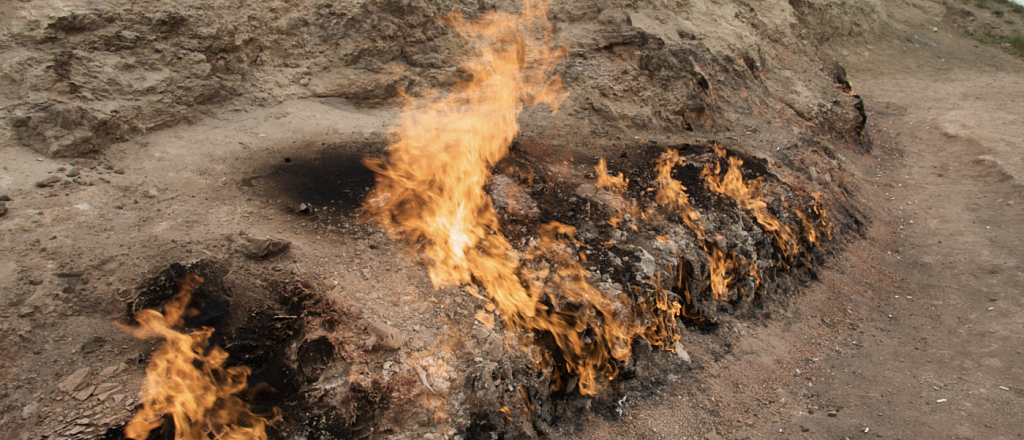
Yanardag means "burning mountain" in Azerbaijani. It is a low limestone hill located 25 kilometers north of Baku, where a strip of open flame about 10 meters wide and 0,5 to one meter high burns continuously at its base.
The cause is the same as at Ateshgah: large natural gas deposits lie beneath the Absheron Peninsula. Gas escapes through porous sandstone and ignites on contact with air. Unlike Ateshgah, the fire here is natural. The mountain burns in all weather conditions — rain or wind. During rainfall, the flames turn a vivid blue.
Since 2007, the area has been designated a state historical, cultural, and natural reserve covering 64,5 hectares. After reconstruction in 2019, a viewing platform and a small exhibition explaining the phenomenon of eternal fires were added. Three flames are depicted on the coat of arms of Baku.
The best time to visit is in the evening or after sunset, when the flames create a much more dramatic effect. Visitors should check closing times in advance.
Practical Tips
Start with Ateshgah. Both sites are located northeast of central Baku, making it convenient to visit Surakhani first and then continue to Yanardag.
Carry cash. Card payments are not accepted everywhere, including some cafes and ticket offices.
It is useful to get a BakuCard — BakıKart for public transport.
Dress comfortably and bring a warm layer — it can get windy at Yanardag.