



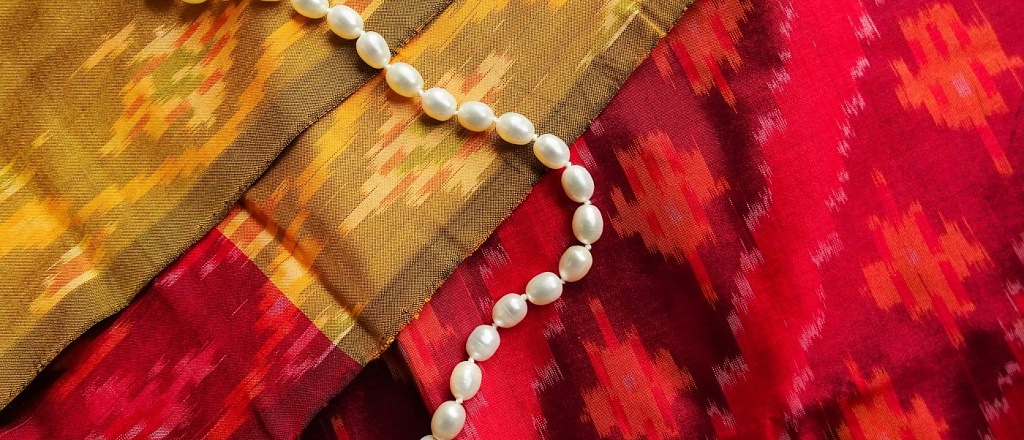

Bukhara is one of Central Asia’s main centers of ikat production. The technique appeared here earlier than in Samarkand and the Fergana Valley, and local artisans still work on handlooms today. Here’s what ikat is, why it is expensive, and where to buy it in the city.
Ikat is one of the world’s oldest textile dyeing techniques. The principle is simple but labor intensive: the threads are dyed first and woven afterward. Before dyeing, sections of the threads are tightly bound so the pigment cannot reach covered areas. Once the bindings are removed and the threads are placed on the loom, they form a pattern with slightly blurred outlines. That "imprecision" is considered the hallmark of handmade ikat: machines create sharp prints, while artisans create living ornamentation.
In the Emirate of Bukhara, ikat fabrics once carried elite status. They were used as diplomatic gifts and tailored into clothing for nobility. Production peaked during the 18th and 19th centuries, when Bukhara, Samarkand, and Kokand became the region’s leading silk weaving centers.
During the Soviet era, production declined, but since the 1990s, the craft has gradually revived. In Bukhara, workshops and boutiques still sell both finished garments and fabric by the meter: adras — a silk and cotton blend, khan atlas, and pure silk ikat.
In 2020, Giorgio Armani released an Armani Privé collection inspired by ikat patterns. The perfumes and bottles in the collection featured ornaments created in the style of the technique.
Below is a selection of places in Bukhara where you can buy ikat: from small boutiques near the trading domes to antique galleries.
Where to Buy Ikat in Bukhara
Feruza Ikat Store, @feruza_ikat
One of the best known ikat boutiques in Bukhara. Feruza Akhrarova opened the shop near the first trading dome close to Lyabi-Hauz and works directly with a master weaver from Margilan. Fabrics here are commissioned according to specific requests for color and ornamentation. The selection includes silk velvet ikat, adras, and cotton ikat. Custom tailoring is available with a 24 hour turnaround.
Akbar House Collection, @akbar_house_collection
An antique gallery near Lyabi-Hauz. Akbar Hakimov spent decades building the collection, with some pieces inherited from his father and grandfather. The gallery offers vintage chapan coats, suzani embroidery, carpets, and folk art from across Central Asia. The space feels more like a museum than a traditional store — less about shopping, more about immersing yourself in textile history.
Nancy Boutique Shop, @nancy_boutique_shop
A boutique focused on ready to wear ikat clothing. Ideal for visitors who prefer not to deal with fabric selection and tailoring. The style is modern, with an emphasis on everyday wearability.
Ikat & Adrass
This workshop operates mostly offline and has little social media presence. It feels closer to a studio than a retail shop — a good place to find unusual fabrics, compare textures, and explore materials in person. It’s best to visit during working hours and be prepared for the selection to depend on current stock.
Silk Ikat Studio
An atelier offering custom tailoring services. If you want not just fabric, but a garment made to your specifications, the studio can help select materials and sew pieces according to measurements.
Gullar Sovgʼalar
The shop occasionally carries interesting textiles, though browsing takes time. Best suited for visitors who enjoy searching carefully and are not in a hurry.
Feruzʼs Ikat Gallery
A gallery focused on authentic rather than mass produced textiles. It caters more to buyers searching for specific handcrafted pieces than generic souvenirs.
What to Know Before Buying
Handmade natural silk ikat usually costs from around $15 per meter for adras to $30-50 per meter for silk velvet. Traditional ikat fabric is also relatively narrow — typically between 35 and 50 centimeters wide. That limitation comes from the size of handlooms.
Authenticity can be checked through several details: the pattern should remain visible on both sides of the fabric, though softer on the reverse, the ornament edges should appear blurred rather than perfectly sharp, and handmade threads may contain slight irregularities or thickened areas. These are not flaws, but indicators of manual production.
Most shops also offer tailoring services. If time allows, it’s better to commission a custom piece rather than buy something ready made.