



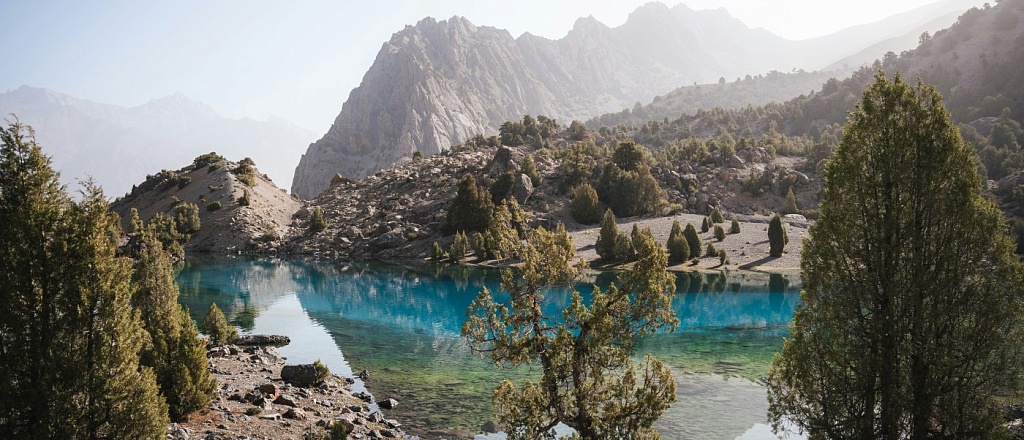

Just 65 kilometers from Samarkand — including the border crossing — an entirely different landscape begins. Beyond Uzbekistan lies Tajikistan: the quiet of ancient Panjakent and the dramatic peaks of the snow covered Fann Mountains. This route is for travelers ready to trade ornate architecture for wild nature and discover the history hidden within the ruins of the "Pompeii of Central Asia".
How to Get There
The drive from Samarkand to the "Jartepa" border crossing takes around 40-50 minutes by taxi. After passport control and a short walk through the neutral zone, you arrive on the Tajik side at the "Sarazm" checkpoint. From there, the center of Panjakent is another 15-20 minutes by taxi. The crossing is open to citizens of most CIS countries, though it is best to check operating hours in advance.
Sarazm
The first stop after crossing the border is the archaeological site of Sarazm. It is the first and only UNESCO World Heritage Site in Tajikistan, added to the list in 2010, and one of the oldest settlements of sedentary peoples in Central Asia: the site dates back to the 4th-3rd millennia BCE, making it more than 5500 years old. The name "Sarazm" translates from Tajik as "where the land begins". The remains of palace complexes, residential buildings, and fire worship altars have been preserved here. By the 4th millennium BCE, Sarazm had become one of the region’s major metallurgy centers: copper, gold, and silver were extracted in the upper Zeravshan Valley and processed on site.
One of the site’s most famous discoveries is the "Princess of Sarazm". In 1984, archaeologists uncovered the burial of a 24 year old woman adorned with thousands of beads made from lapis lazuli, carnelian, and turquoise, along with 49 gold beads woven into her headdress and a bronze mirror. Her exact identity remains unknown, but the richness of the burial suggests a high social status. Her remains and jewelry are now housed in the National Museum of Antiquities of Tajikistan in Dushanbe, while a monument in her honor stands near the archaeological reserve. Only around 10% of Sarazm has been excavated so far — most of the ancient settlement still lies underground.
Ancient Panjakent
On the southeastern edge of the modern city, overlooking the Zeravshan River, lie the ruins of ancient Panjakent — one of the most important monuments of Sogdian culture from the 5th-8th centuries CE. It is often called the "Pompeii of Central Asia": in 722, Arab forces captured the city, its residents fled, and never returned. Like Pompeii beneath the ash of Vesuvius, the cultural layer remained remarkably preserved.
Excavations began in 1946 and continue today. Archaeologists have uncovered residential quarters, a citadel, two adjacent temples dedicated to Zoroastrian and pagan cults of natural elements, rulers’ palaces, and wealthy homes decorated with elaborate frescoes depicting feasts, battle scenes, and epic narratives. Most original frescoes are now kept at the State Hermitage Museum in Saint Petersburg and the National Museum of Tajikistan in Dushanbe. Copies and artifacts can still be seen at the Rudaki Museum in modern Panjakent. The archaeological site itself is open to visitors.
Rudaki Museum
In the center of modern Panjakent is the Abuabdullo Rudaki Museum, dedicated to the great Persian Tajik poet of the 9th-10th centuries, who was born in this region. The museum houses archaeological finds from the ancient city, fresco reproductions, and everyday objects from Sogdian life. It is an ideal place to understand the historical context before visiting the ruins.
Modern Panjakent and Local Cuisine
Panjakent is a small and welcoming city. Visit the local bazaar for mountain honey, dried fruits, and freshly baked tandoor bread. Try Panjakent plov, which differs noticeably from the Samarkand version. It is lighter, with a stronger emphasis on local rice varieties and the spices of the Zeravshan Valley. Traditional teahouses serve kok-chai, along with classic Tajik dishes such as oromo, lagman, and shurpo.
The Seven Lakes of Haftkul
The entire chain extends roughly 14 kilometers along the road. It is possible to drive as far as the sixth lake, Marguzor, in a standard car — the road is unpaved and winding, but manageable. The final stretch to Hazorchashma is best completed on foot, taking around 40-60 minutes each way along a mountain stream. Exploring all seven lakes usually takes a full day. The best time to visit is from May to October. In July and August, the lower lakes become warm enough for swimming.
Practical Tips
The currency in Tajikistan is the somoni. Exchange offices are available at the border and in the city, but cash is still more convenient than cards in most places.
If you plan to stay longer, consider buying a local SIM card such as Tcell or Babilon.
For trips into the mountains, it is best to hire a local driver from the taxi stand in the city center — locals know the mountain roads and changing conditions well.
The best season for this route is from April to October. In winter, mountain passes leading to the lakes are usually closed.
Visa regime: visa free entry is available for citizens of Kazakhstan, Kyrgyzstan, Russia, Belarus, and several other CIS countries. Travelers from other countries should check visa regulations in advance through official embassy websites.