



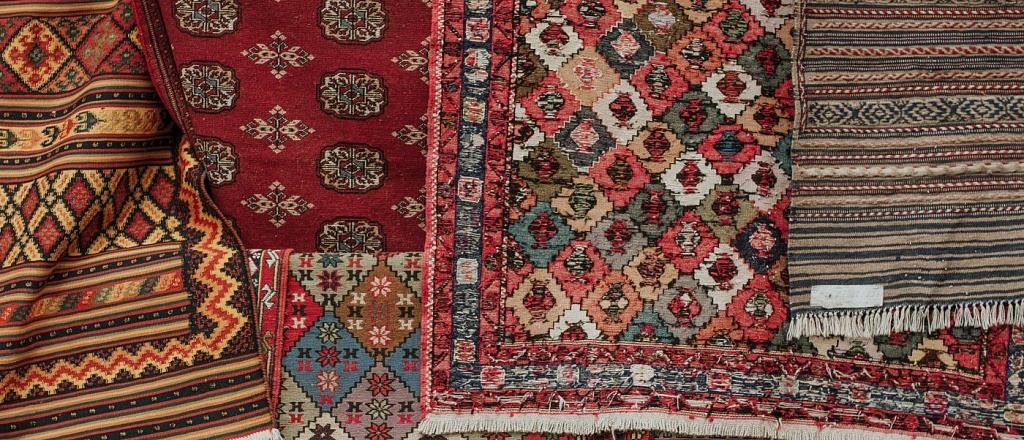

Five ornamental patterns appear on the flag and coat of arms of Turkmenistan — and they are far more than decorative motifs. Each belongs to a specific tribe and has been passed down through generations. A handmade Turkmen carpet is one of the few objects in the world whose value is defined by time, origin, and the impossibility of replicating its meaning. Here is what these carpets are made of and why collectors prize them so highly.
The Language of Ornament
Turkmen carpets are recognized by their gyol — an octagonal medallion that serves as a tribal emblem. The five main gyols belong to the country’s five largest tribes: Akhal Teke, Yomut, Salyr, Chowdur, and Ersary. All five appear on the national flag and coat of arms of Turkmenistan, symbolizing the country’s five velayats and the unity of its people. Buying such a carpet means acquiring more than a pattern — it means owning a piece of a specific cultural lineage. Persian carpets are known for their rich color palettes, while Turkmen carpets are more restrained, geometric, and structured.
The dominant color is deep red or burgundy. Historically, red symbolized life giving natural forces and protection in Turkmen culture. Blue backgrounds are rare and mostly found in Yomut tribal carpets. The ornaments contain solar symbols, animal imagery, and abstract motifs rooted in pre Islamic beliefs.
The dominant color is deep red or burgundy. Historically, red symbolized life giving natural forces and protection in Turkmen culture. Blue backgrounds are rare and mostly found in Yomut tribal carpets. The ornaments contain solar symbols, animal imagery, and abstract motifs rooted in pre Islamic beliefs.
Handmade as the Standard
Turkmen carpets are woven entirely by hand — every knot is tied individually. The finest examples reach densities of up to 1 350 000 knots per square meter, as seen in certain historic museum pieces. High quality carpets typically range between 300 000 and 500 000 knots per square meter. This density determines the sharpness of the design, durability, and ultimately the price. Even with continuous work, a single carpet requires at least six months to complete. An experienced weaver ties around three thousand knots per hour and repeatedly beats the fabric with a heavy metal comb to compact the pile.
Natural Dyes and Wool
Traditional Turkmen carpets are made from pure sheep’s wool, valued for both softness and durability compared to synthetic fibers. Some tribes also use cotton or silk for the foundation and weft threads. Until the 19th century, all dyes were sourced from plants and minerals: madder root produced red, larkspur and pomegranate roots created yellow tones, and indigo provided blue. In the 20th century, cheaper aniline dyes largely replaced natural pigments, leading to a noticeable decline in quality. Today, traditional artisans are gradually returning to natural materials. One reason antique carpets are more valuable than new ones is that natural dyes do not simply fade over time — they develop deeper, more complex tones.
Why They Cost More Than Persian Carpets
Handmade Persian carpets are also luxury items, but Iran’s carpet market is significantly larger and more commercially diversified. Carpets are produced across dozens of regions — including Tabriz, Nain, Qom, and Isfahan — with varying levels of quality and price. Alongside handmade production, machine made carpets are also widely sold under similar regional names. Turkmen carpets, by contrast, are unambiguous: they are always handmade and always tied to tribal identity. For centuries, Turkmen carpets entered European markets under the labels "Persian" or "Bukhara" carpets. While this did not diminish their quality, it obscured their origin. When Marco Polo traveled through Central Asia in the 13th century, he described Turkmen carpets as "the thinnest and most beautiful in the world".
A Carpet as National Heritage
Turkmenistan is the only country in the world where the carpet is officially recognized as a national symbol. Since 1992, the country has celebrated Turkmen Carpet Day every year on the last Sunday of May. In the center of Ashgabat stands the National Carpet Museum, founded in 1993 and considered unique in the world. Its collection includes around 2 000 carpets from different eras, mainly dating from the 17th to the 19th centuries. The museum houses the world’s largest handmade carpet: 301 square meters in size and weighing 1,2 tons. It was woven by 38 artisan women over seven months, working in three shifts. In 2003, the carpet was added to the Guinness World Records. Inside the museum’s restoration workshop, one square meter of an antique carpet may contain as many as 1 350 000 knots.
Turkmen carpet weaving survived not because it was preserved as heritage, but because it continued to be made by hand, slowly and deliberately, with an understanding that the work would outlive its creator.
Where to Buy
The most reliable place to purchase an authentic Turkmen carpet is the museum shop at the National Carpet Museum in Ashgabat, where carpets come with export certification from the Ministry of Carpets of Turkmenistan.
Outside Turkmenistan, handmade Turkmen carpets are also sold in Kazakhstan and Uzbekistan.
Tumar Carpets galleries in Astana and Almaty offer international shipping — @tumar.carpets.
Luxury carpet salon in Tashkent, including Turkmen carpets — @az_carpets_.